
Bus Buddies – Bus Jam Unity Source Code
$34.00
- 100 levels in 5 regions
- 11 mechanics
- 4 power-ups
- 8 animal species
- Level Editor
- Admob
- In-App Purchase
Description
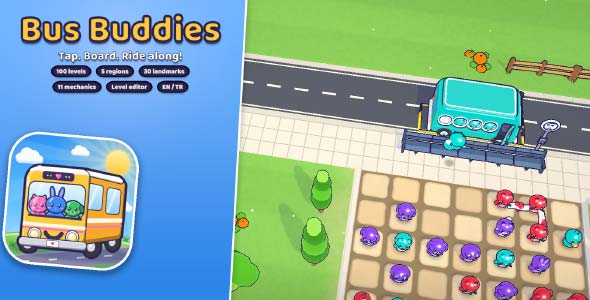
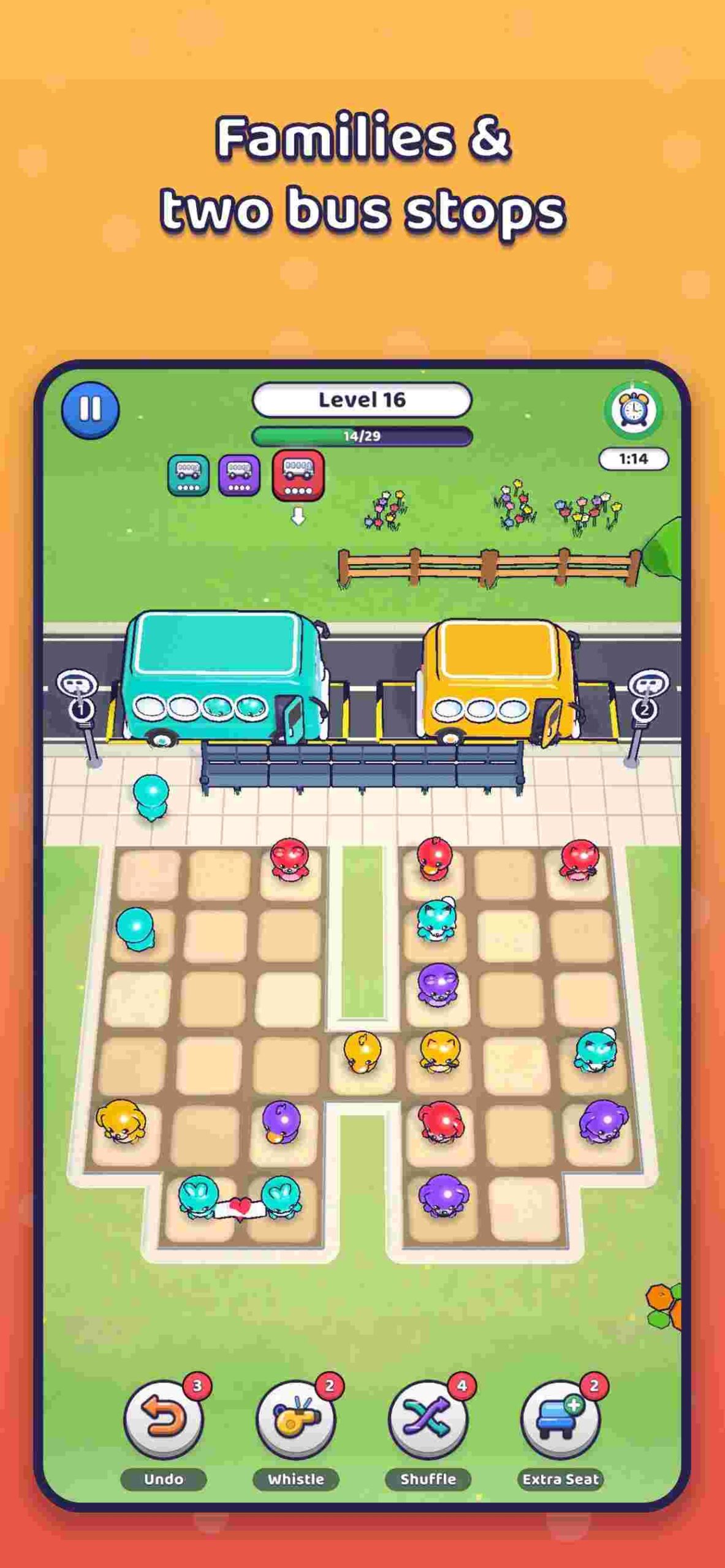
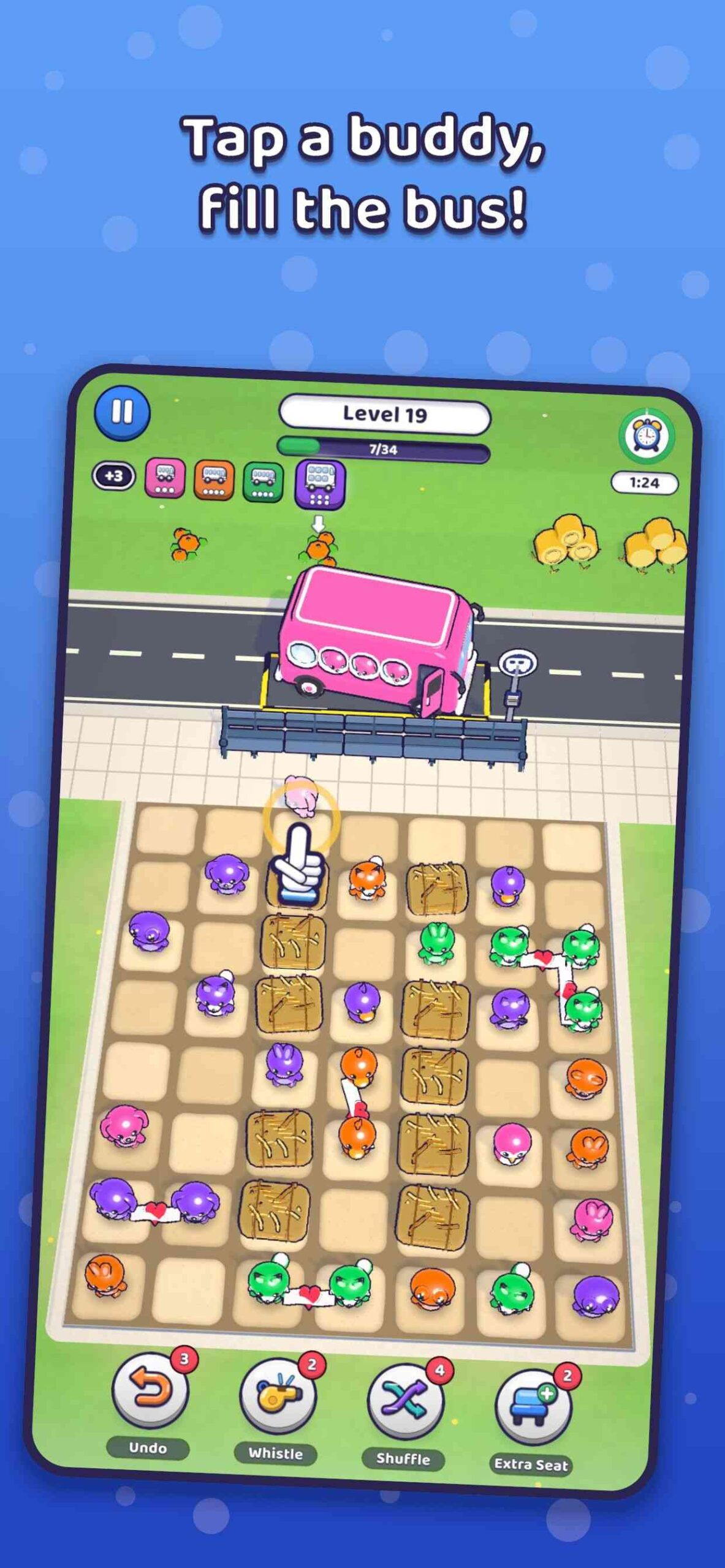
Bus Buddies – Bus Jam Unity Source Code is a trending template where cute toy animals wait on a town plaza and buses of every color pull up at the stop. The player taps a buddy that has a free way to the top row of the plaza: it walks out and hops onto the waiting bus of its color, or sits on the waiting bench when no bus of its color is there. A full bus honks and drives off and the next bus of the queue pulls in, and buddies on the bench board an arriving bus of their color by themselves.
Board every buddy to win; a full bench (“Out of space!”) or no possible move (“No moves left!”) fails the attempt, and Continue buys one more bench seat. A clear pays coins and up to three stars, and the stars rebuild the landmarks of each region’s town.
The twist is planning. The bench has only 5 seats, so the order of the taps decides the level: free the way for the colors that are coming, and park only what the next buses will pick up. Families of two or three buddies hold hands and need their seats together, two bus stops let two buses wait at once, and buses come in three sizes (3, 4 and 6 seats). Every region adds its own mechanic: hidden buddies under a “?” box show their color only once they have a way out, sleepy buddies wake when a cell next to them is emptied, ice melts by one with every move, tunnels release a queue of buddies whenever their door cell is free, VIPs never sit on the bench, and locked gates open when the buddy wearing the matching key leaves the plaza. Every level is generated backwards from a known solution, proven solvable by a solver and measured with a bot player against a target difficulty band, then baked into an asset, so every player gets the same fair level.
The content: 5 regions with their own town diorama, plaza tiles, wall props, lighting, post-processing, music and ambience (Sunny Farm, Maple Woods, Frosty Bay, Sunset Savanna and Candy Town), each with 20 levels in a sawtooth curve of Normal, Hard and Super Hard levels and a region finale. 11 mechanics (walls, the 4-seat bus, the 6-seat double-decker, families, two stops, hidden, sleepy, ice, tunnels, VIPs, gates and keys), each introduced with a “New!” card.
8 animal species (Kitty, Puppy, Bunny, Bear Cub, Fox, Duckling, Frog, Penguin), each with its own voice, in 8 team colors with an optional color-symbol setting for color-blind players. 11 plaza shapes, plazas from 4 x 4 to 9 x 11 cells with up to 78 buddies, 4 power-ups (Undo, Whistle, Shuffle, Extra Seat), 3 stars per level with a par time, 5 lives that come back over time, 30 landmarks (6 per region) to build with stars, a map with all 100 levels, a shop with a Starter Bundle, No Ads and three coin packs, 4 rewarded ad placements, a first-session tutorial with a pointing hand and English and Turkish texts (296 strings). A Level Editor window paints, validates (solver and bot), generates and plays single levels.
The whole bus jam game source code is built from scratch. Editor builders turn C# tables into the data assets (including the 100 baked levels), materials, post-processing profiles, effects, prefabs, UI sprites, icons, the UI and both scenes, so Bus Buddies > Build > Build Everything regenerates all of them (a level only when its recipe or the generator changed); every price, reward, timer, unlock level and content table lives in one file, EconomyDefaults.cs, and every level recipe in LevelCurve.cs. The puzzle is a pure, deterministic C# simulation without Unity types: the same code runs the game, the solver, the bots, the level generator, the Level Editor, the tests and the command-line tool puzzle_cli outside Unity.
The views animate the simulation’s events on their own queues, so the player can tap again at once; buddies, buses, family ribbons, speech bubbles and the 29 particle effects are pooled. 14 own URP shaders, own small libraries for tweening, pooling, saving, localization, audio, haptics, splines and random numbers, a signed JSON save with a backup file, CSV localization and native haptics (iOS plugin, Android vibrator).
Ads and in-app purchases sit behind interfaces with working mock services, so every flow runs in the editor without any SDK: rewarded ads for first-clear coins x2, a Continue, an extra life and a free power-up (3 a day); an interstitial when the player leaves the results or the “Level Failed” panel (from level 10, after every 2nd finished attempt, at least 75 seconds apart, never within 60 seconds after a rewarded ad, never with No Ads); and a Starter Bundle, No Ads and three coin packs as in-app purchases.
An AdMob adapter compiles with the BUSBUDDIES_ADMOB scripting define once the buyer installs the Google Mobile Ads Unity plugin v9 or newer, and a Unity IAP adapter compiles by itself when com.unity.purchasing 4.8 or a later 4.x version is installed (its assembly sets the BUSBUDDIES_UNITY_IAP version define; Unity IAP 5 is not supported). Both are then switched on in one config asset; until then the mock services stay active, also in player builds.
1087 edit mode test cases are included (Run All runs 887; two explicit runs that build and validate all 100 levels, 100 cases each, run on their own), plus 14 play mode tests: smoke tests with a bot that plays the real scenes through the UI and a runtime test on two portrait screen sizes (8 cases) run by default; an explicit soak run in which the bot clears all 100 levels and builds every landmark, and the 5 screenshot tours, can be run by hand.
All code was written for Bus Buddies, and every asset is produced by generators that ship with it: the 119 FBX models by Blender 3.6 Python scripts (Tools/Blender), the 42 sound effects (59 files with variants), 6 music loops and 5 ambience loops by a Python synthesizer (Tools/Audio), the colour palette by Tools/Palette, the UI symbol font (stars, check marks, crosses, hearts) by Tools/Fonts, the UI sprites, icons and app icon by C# editor code with signed distance functions, and the buddy portraits and landmark icons by an icon baker that renders the 3D models.
Third-party content is limited to one font and Unity’s own TextMesh Pro resources: Baloo 2 (SIL Open Font License 1.1, license text next to the font) and the LiberationSans fallback font that comes with Unity’s TextMesh Pro essential resources (SIL OFL 1.1, license text included). Both may be used commercially. Those essential resources also hold Unity’s unused sample emoji sheet (EmojiOne, CC-BY 4.0, with its attribution file). No SDKs and no Asset Store packages are included or required. Full documentation: a start-here README, a 23-chapter manual with a step-by-step Android and iOS release guide, a developer guide and a game design document with every rule and number.
Requirements
- Unity 6000.0.85f1 or a later 6000.0 LTS patch; URP 17.0.4, uGUI 2.0.0
You must be logged in to post a review.


Reviews
There are no reviews yet.